Customer attention isn’t what it used to be. Shoppers process information quickly, make faster decisions, and expect immediate value the moment they enter a store.
At the same time, physical retail faces constant pressure from e-commerce. Online platforms offer convenience, personalization, and instant access to information, setting a high benchmark for the in-store experience.
To stay competitive, brick-and-mortar environments must do more than display products. They need to actively guide and influence customer decisions.
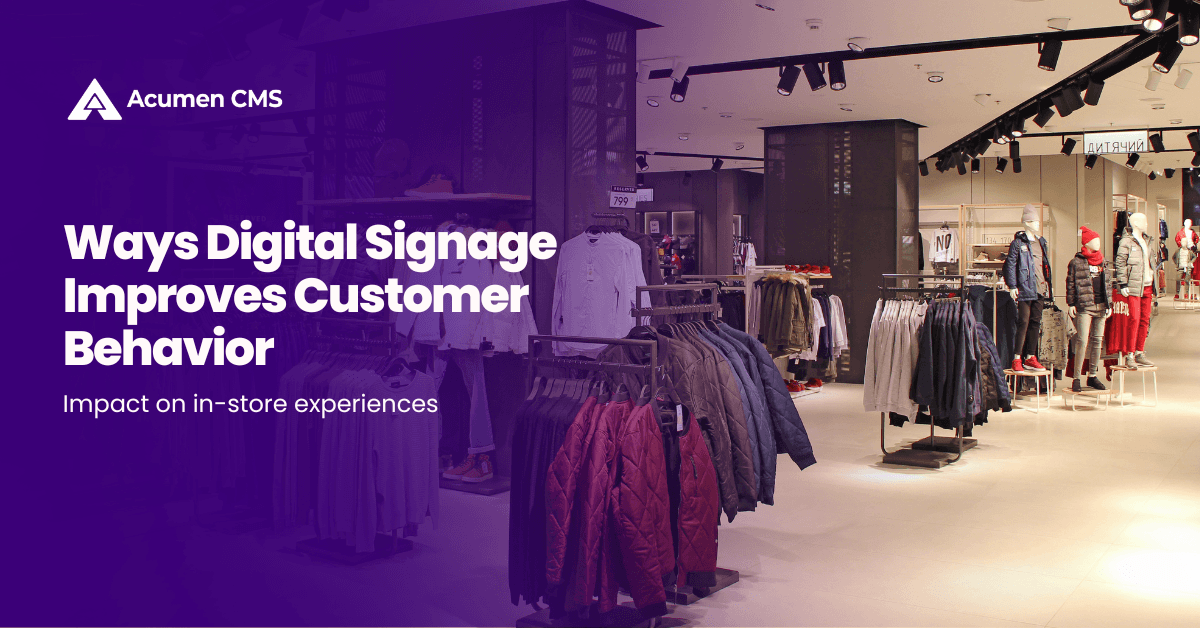
This is where digital signage plays a strategic role. When implemented thoughtfully, it shapes how customers navigate the space, what captures their interest, and how they respond to promotions and product messaging.
In this blog, we will discuss the 7 Ways Digital Signage Improves In-Store Customer Behavior.
Key Ways Digital Signage Enhances In-Store Customer Behavior
The following points outline how digital signage directly impacts shopper engagement and purchase decisions:
1. Influences Impulse Buying Decisions
Impulse purchases rarely happen by accident. They’re triggered in the moment, often by what customers see, feel, or suddenly notice.
Digital signage acts as a powerful visual trigger. Bright displays, high-quality product visuals, and dynamic layouts draw the eye far more effectively than static posters. When customers see a product in action or presented in an aspirational setting, it creates immediate desire.
The decision shifts from “Do I need this?” to “Why not get it now?”
Limited-time offers amplify this effect. Countdown timers, flash promotions, and time-bound discounts introduce urgency. When shoppers feel they might miss out, hesitation decreases, and quick decisions follow.
Motion-based content strengthens both impact and recall. Movement naturally captures attention, especially in busy retail environments. A short animation or rotating offer can interrupt browsing patterns just enough to redirect focus and drive spontaneous purchases.
2. Increases Dwell Time in High-Margin Areas
Retail success often comes down to one simple factor: time spent in front of the right products.
This is where The Slow-Down Effect comes into play. When digital screens are placed near premium or high-margin shelves, they naturally draw attention and pause movement. Shoppers slow down. They look up. And in doing so, they spend more time on higher-value items.
That extra time matters.
Dynamic promotions running alongside these products reinforce their value. A short feature highlight, a benefit-driven message, or a limited upgrade offer keeps eyes on the display and, by extension, on the product itself. The longer customers engage in that zone, the higher the likelihood of a considered purchase.
3. Guides Customer Movement Through the Store
Large retail spaces can be overwhelming.
When customers walk into a big-format store, they often spend the first few minutes simply trying to figure out where things are.
Electronics? Toys? Home essentials?
That confusion slows momentum and, in some cases, shortens the visit altogether. Digital signage solves this through clear wayfinding and smart zoning strategies.
Well-placed screens act as visual anchors. A display that points shoppers toward the electronics section or highlights where kids can find toys immediately reduces friction. Customers don’t have to search or ask for help; they move with confidence.
And that clarity benefits the store just as much as the shopper.
When signage is positioned using proven placement practices, it creates a natural flow across departments. Teams spend less time giving directions and more time supporting purchase decisions. Traffic spreads more evenly, and priority categories gain consistent visibility.
4. Reduces Perceived Wait Times at Checkout
Checkout lines are unavoidable, but how customers experience them can be managed. There is a clear difference between actual time and perceived time.
A five-minute wait remains five minutes on the clock, yet when customers are engaged with relevant content, it can feel closer to two. When attention is occupied, time feels compressed.
Digital signage in queue areas works by shifting focus away from the wait itself. Instead of watching the line move slowly, customers engage with purposeful content that keeps their minds active and their mood steady.
Effective queue content may include:
- Product tips or short demonstrations
- Cross-sell recommendations tied to common purchases
- Loyalty program reminders or seasonal updates
- Light, brand-aligned entertainment
This distinction between actual and perceived time directly impacts behavior. When the wait feels shorter, frustration decreases, and the likelihood of last-minute cart abandonment at checkout drops significantly. The shopping journey ends with less friction, which strengthens overall customer satisfaction and return intent.
5. Strengthens Brand Recall Inside the Store
Brand recall doesn’t happen through one interaction. It builds through consistent exposure.
Digital signage helps maintain a uniform visual across the store. From entrance displays to aisle-level screens and checkout messaging, the use of consistent colors, typography, imagery, and tone reinforces a unified brand identity. Customers begin to recognize the brand not just by name, but by look and feel.

Repetition psychology plays a key role here. When shoppers encounter aligned messaging multiple times during a single visit, familiarity increases. That familiarity strengthens memory retention and reduces hesitation during decision-making.
The repetition is intentional but not overwhelming. By presenting varied content within a consistent visual framework, digital signage ensures the brand remains top of mind long after the customer leaves the store.
6. Drives Upselling and Cross-Selling
Upselling and cross-selling work best when suggestions feel relevant, not random. Digital signage makes this possible by placing targeted prompts exactly where purchase decisions happen, near product displays, comparison zones, and checkout areas.
Instead of relying only on staff intervention, screens consistently surface logical next steps.
For example:
- Combo suggestions: A screen near laptops promoting a bundle that includes a wireless mouse and an extended warranty.
- Complementary add-ons: A display in the skincare aisle recommending a moisturizer to pair with a cleanser already in the cart.
- Premium upgrades: Highlighting the benefits of a higher-spec model next to a standard version to justify the price difference.
- Time-sensitive pairings: Showcasing seasonal bundles or limited offers tied to popular products.
Because these prompts are visual and context-driven, they feel like guidance rather than sales pressure. Customers see added value in real time, which increases average transaction size while maintaining a smooth shopping experience.
7. Improves Decision Confidence
Many in-store purchase decisions stall because customers are unsure. They compare options, read packaging, check their phones, and often delay the decision simply because they lack clarity.
Digital signage helps remove that uncertainty at the exact point where it matters. Product explainer videos demonstrate how an item works, highlight key features, and show real-life use cases in a concise format. Instead of guessing or searching online, customers receive immediate, visual confirmation of value.
In addition, displaying social proof such as customer testimonials or ratings reinforces trust. When shoppers see that others have chosen the product and had a positive experience, hesitation naturally declines.
By combining clear information with credible validation, digital signage strengthens confidence in decisions and moves customers from consideration to purchase more smoothly.
Conclusion
Digital signage is not just a display tool, it’s a behavior driver. When used strategically, it influences decisions, reduces hesitation, increases basket size, and turns a browsing shopper into a confident buyer.
The difference lies in data-driven execution. The right content, placed at the right moment, delivers measurable results from higher dwell time to stronger in-store conversion. To make that happen, you need control and flexibility.
Acumen CMS helps you customize, schedule, monitor, and optimize your digital signage with ease. Trusted across thousands of screens nationwide, it empowers businesses to deliver the right message at the right moment.
Ready to turn engagement into revenue? Book a demo today!